English| EUR
Suggested for you
More currencies
Choose a language
The 415-kilometre line between Ban Pong in Thailand and Thanbyuzayat in Burma was finished in roughly sixteen months, and the name it carries was earned during those months rather than assigned afterwards. This why is it called the death railway guide sets out where the name came from, who applied it, and which sites in Kanchanaburi hold the records behind it.
Quick answer
It is called the Death Railway because roughly 12,000 Allied prisoners of war and an estimated 90,000 Asian labourers died building it for the Imperial Japanese Army between June 1942 and October 1943. Survivors coined the term; it stuck. The Thailand–Burma Railway Centre, which charges 160 THB for foreign adults, documents the toll with camp records and route maps.
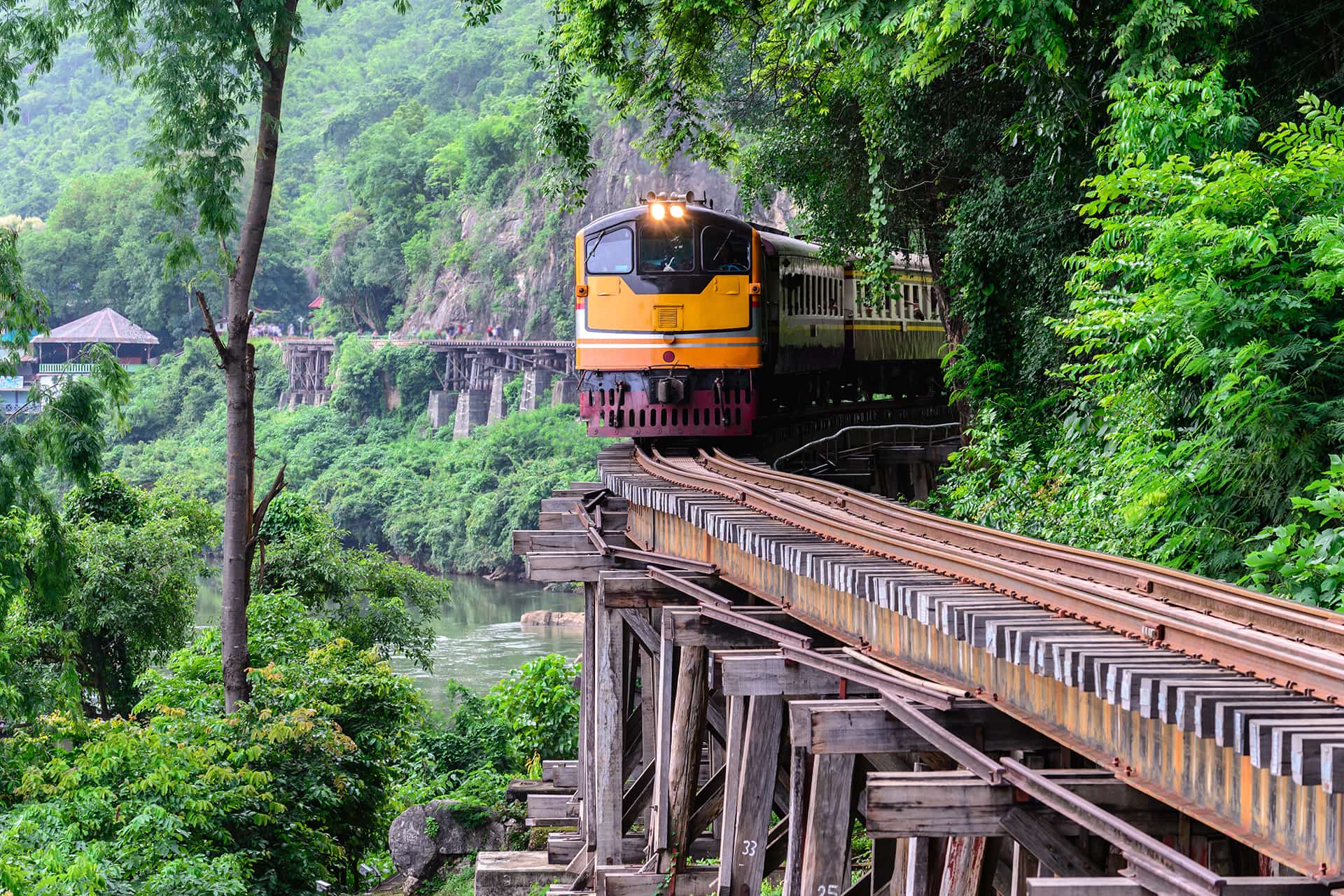
The line was scheduled to take five years. It was finished in sixteen months, and that compression is the whole answer to why is it called the death railway. Engineers had surveyed the route through the Tenasserim Hills before the war and judged it impractical. In 1942 the Imperial Japanese Army built it anyway, using captured men and conscripted labour instead of machinery, and the mortality rate rose in direct proportion to the speed demanded. Two populations died on the route, and visitors often learn about only one. Around 60,000 Allied prisoners of war — British, Australian, Dutch and American — were put to work, and roughly one in five did not survive. Alongside them worked romusha, Asian labourers recruited under false promises from Malaya, Burma, Java and Thailand, whose deaths were never systematically recorded; estimates cluster near 90,000. Cholera, beriberi, tropical ulcers and starvation killed far more than accidents did. The worst stretch, a cutting through solid rock at Konyu, became Hellfire Pass, named for the torchlight that lit night shifts. The Thailand–Burma Railway Centre on Chao Khun Nen Road holds the camp ledgers, and the Kanchanaburi War Cemetery lies directly opposite it. This matters for how a visit is planned. The Bridge on the River Kwai draws the crowds, but the steel span is only one structure on a 415-kilometre line, and the film that made it famous invented most of its plot. Anyone booking a Death Railway tour from Bangkok will find the historical weight sits elsewhere: at Hellfire Pass, on the Wampo viaduct, and in the two war cemeteries where the dead are named. Reading the museum first turns the train ride from scenery into evidence. The practical order is straightforward. Start at the interpretive centre opposite the cemetery, then travel the surviving section of track toward Nam Tok. Kanchanaburi's landmarks reward that sequence because the terrain only reads as brutal once the numbers are known. Understanding why is it called the death railway takes about an hour of reading; the line itself takes a day.
“The line was scheduled to take five years. It was finished in sixteen months, and that compression is the whole answer.”
The line was born of strategy, not commerce. After Japan occupied Thailand in December 1941 and seized Burma by May 1942, the sea route through the Strait of Malacca grew perilous under Allied submarines. Imperial General Headquarters ordered an overland supply link. Construction began in June 1942 from both ends — Nong Pladuk in Thailand and Thanbyuzayat in Burma — under the Japanese 5th and 9th Railway Regiments. British engineers had surveyed the same corridor early in the twentieth century and shelved it as impractical. Japan compressed the estimated five-year schedule into sixteen months. Roughly 61,000 Allied prisoners of war and an estimated 180,000 to 250,000 romusha — conscripted labourers from Malaya, Java, Burma and Indochina — cut 415 kilometres of track through limestone and jungle. Answering why is it called the death railway begins with the arithmetic of that workforce. Around 12,600 POWs died. Romusha deaths are thought to have exceeded 90,000, though records were never properly kept. Cholera swept the upcountry camps in mid-1943. Beriberi, dysentery and tropical ulcers did the rest. During the "Speedo" period of June to October 1943, men worked eighteen-hour shifts by carbide lamp at Konyu Cutting, where some 69 prisoners were beaten to death. The rock passage is known as Hellfire Pass. The two ends met at Konkoita on 17 October 1943. The wooden trestle bridge and the concrete-and-steel span at Tha Ma Kham — popularised as the bridge on the River Kwai — were bombed repeatedly by the RAF and USAAF between November 1944 and June 1945. Two central spans were destroyed and later replaced by Japan as war reparations; the angular replacements remain visible today. Visitors seeking why is it called the death railway will find the answer distributed across Kanchanaburi's landmarks: 6,982 graves at Kanchanaburi War Cemetery on Saengchuto Road, 1,693 more at Chungkai, the surviving Wampo Viaduct clinging to the cliff, and the research archive at the Thailand-Burma Railway Centre on Chao Khun Nen Road, which holds camp records, roll-call ledgers and the personal effects of men who never left the valley.
Japanese forces land in Thailand and secure passage toward Burma.
Construction begins simultaneously at Nong Pladuk in Thailand and Thanbyuzayat in Burma.
Cholera epidemics devastate the upcountry camps along the Thai-Burmese border.
The "Speedo" period drives eighteen-hour shifts at Konyu Cutting, later named Hellfire Pass.
The Thai and Burmese sections meet at Konkoita, completing 415 kilometres of track.
Allied bombing raids begin against the Tha Ma Kham bridges over the Mae Klong.
War graves are consolidated at Kanchanaburi War Cemetery, holding 6,982 burials.
The Wang Pho to Nam Tok section reopens for passenger service under Thai State Railways.
The Thailand-Burma Railway Centre is open daily to provide context regarding the history of the railway. Visitors may plan their visit according to the following schedule.
The best time to visit is during the morning hours, specifically between 09:00–11:00. Arriving within this window allows visitors to explore the sites before the afternoon heat peaks and large tour groups arrive.
Cooler, dry, 20°C to 30°C
This period offers the most comfortable walking temperatures for outdoor memorials.
Hot, humid, 30°C to 40°C
Heat levels are significant, making early morning arrivals essential for comfort.
Rainy, 25°C to 33°C
Expect periodic rainfall, though sites are generally less crowded during these months.
—
Mid-week visits provide the quietest atmosphere for viewing historical exhibits.
Verdict: Plan your visit for a weekday morning between 09:00–11:00 during the cooler months of November to February.
The Thailand-Burma Railway Centre is located at 73 Chao Khun Nen Rd, Ban Nuea, Mueang Kanchanaburi District, Kanchanaburi 71000, Thailand. The most efficient way to reach the center from Bangkok is by train or private transfer.
Thonburi Station to Kanchanaburi Station
Bangkok Southern Bus Terminal to Kanchanaburi Bus Station
Route 4 and Route 323 from Bangkok
Plan your travel to reach the centre between 09:00–11:00. Arriving within this window helps you avoid afternoon heat and peak tour bus crowds.
Everything you need to know about why is it called the death railway
It is called the death railway because of the extreme conditions, disease, and starvation faced by the prisoners of war and forced laborers who built it. The loss of life during the construction was catastrophic, leading to its somber historical name. Researchers often investigate why is it called the death railway to understand the human cost of this World War II project. Visitors seeking to know why is it called the death railway often find the answer in the detailed exhibitions at the museum. Finally, reflecting on why is it called the death railway serves as a poignant reminder of the site's tragic past.
The line was constructed by Imperial Japan to supply their troops during the Burma campaign. Tens of thousands of allied prisoners of war and forced laborers perished due to brutal working conditions. Today, this route remains one of the most significant Kanchanaburi landmarks. Understanding the context helps explain why is it called the death railway in historical discourse.
The entrance fee for the Thailand-Burma Railway Centre is 160 THB for foreign adults. This fee supports the maintenance and historical preservation efforts of the facility. Please refer to our booking widget for any associated tour information.
The centre is open daily from 09:00 to 16:00. This schedule remains consistent throughout the week, including weekends. Visitors can plan their trip knowing these hours are standard.
The best arrival window is between 09:00 and 11:00. Arriving early helps you avoid the afternoon heat and large crowds from tour buses. This timing allows for a more reflective experience at the museum.
Yes, families are welcome to explore the exhibits, which offer educational insights for all ages. It provides a meaningful way to learn about history together. Please ensure children are supervised during your visit.
The museum is located at 73 Chao Khun Nen Rd, Ban Nuea, Mueang Kanchanaburi District, Kanchanaburi 71000, Thailand. It is centrally situated for those exploring the area. You can easily find it near the main historical sites.
Locally, it is known as the Burma Railway. This term is often used alongside the descriptive historical name when discussing the route.